
Enterprise E-Commerce
Simplifying a complex, configuration-dependent marine catalog and turning online research into dealer-ready intent.
- Client
- White-label — confidential marine enterprise client
- Category
- E-Commerce · Marine · Navigation UX
- Year
- 2025-2026
The problem
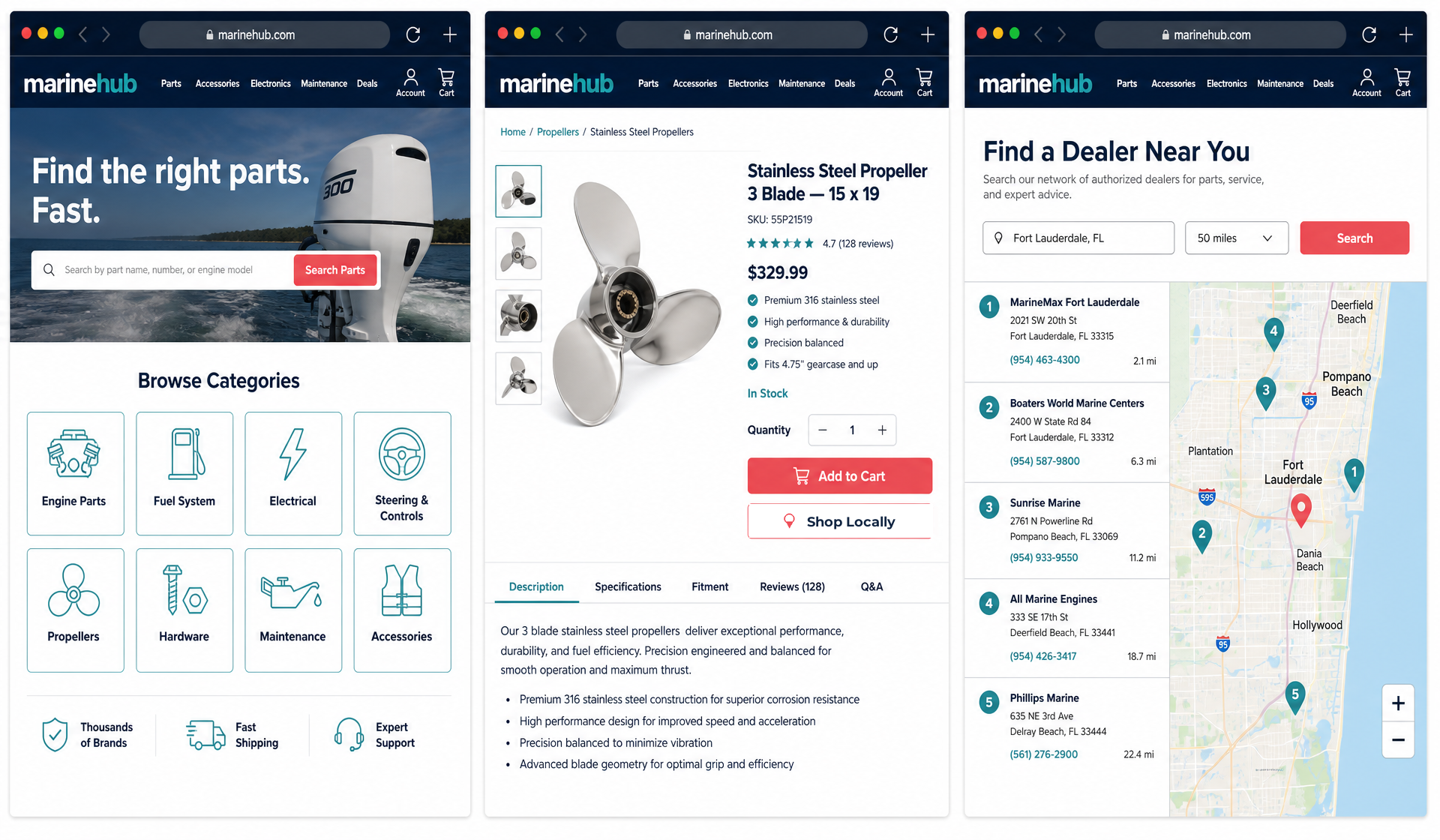
A marine manufacturer needed to sell a high-consideration, configuration-dependent catalog — engines, propellers, parts, and rigging — online without replacing its dealer network. Buyers needed to find parts by engine serial number, horsepower, and image, and the business needed a handoff path from digital research to local dealer. I led and designed a new 'Locally' approach, in partnership with executive leadership and an external vendor, to improve sales results by highlighting local dealers, promotions, and inventory. I also proposed integrating visual and conversational AI search — including Google Lens-style image recognition — to reduce reliance on input fields and create a more organic, real-world shopping experience. The complexity was not just navigation; it was aligning a shared component library with an external e-commerce platform and executive leadership across multiple brands.
My role
UX Lead — Design Strategy & Enterprise Systems
- Owned the UX strategy and end-to-end design for the e-commerce flow and global navigation, working inside a Product Triad of Product, Engineering, and Design.
- Partnered with an outside vendor and executive leadership to define branded components that felt native while operating on a third-party e-commerce platform.
- Built the entire e-commerce experience from the enterprise design system — color, type, spacing, components, and tokens — ensuring consistency across the product portfolio.
- Designed a compatibility-driven Parts Finder supporting search by serial number, engine specs, and part name, and restructured navigation to scale across engines, propellers, parts, accessories, and service.
- Proposed integrating Google Lens-style visual search and conversational AI into the search experience to reduce input-field dependency and simulate the organic, real-world way customers shop for parts.
- Led and designed a new 'Locally' dealer activation model in partnership with executive leadership and an external vendor to improve sales results and highlight local dealers, promotions, and inventory.
- Created a geolocated dealer locator that distinguishes dealers, in-stock retailers, and certified service centers, closing the loop between online research and local purchase.
Process
- Step 01
E-Commerce Strategy
Defined the navigation and discovery model for a configuration-dependent catalog, balancing digital self-service with dealer referral for high-consideration purchases.
- Step 02
Visual & Conversational AI Search
Proposed Google Lens-style image recognition and natural-language search to let customers find parts by photo or voice, reducing input friction and mirroring the way people shop in the real world.
- Step 03
Enterprise Design System
Built the entire experience from shared tokens and components, so the brand remained consistent across the site and the broader product portfolio.
- Step 04
Locally Dealer Activation
Led and designed a new 'Locally' approach in partnership with leadership and an external vendor to improve sales results by spotlighting local dealers, regional promotions, and local inventory within the e-commerce experience.
- Step 05
Dealer-to-Digital Handoff
Designed a dealer locator and product-detail patterns that make online research actionable for local dealers while preserving the dealer relationship.
Measurable results
Designing for a complex catalog is as much about governance as it is about wayfinding. A shared system and a clear vendor partnership were the real product — the UI was the proof it worked.
A digital catalog that respects the dealer relationship
This engagement was the e-commerce strategy and UX for a marine engine, parts, and accessories catalog. Work was built inside a shared enterprise design system and integrated with an external e-commerce platform. I led and designed a new 'Locally' dealer activation approach to improve sales results by spotlighting local dealers, promotions, and inventory, with discovery and purchase paths designed to complement — not replace — the dealer network.
Where the design work concentrated
Site navigation
Restructured global navigation for wayfinding across engines, propellers, parts, accessories, and service.
Visual & conversational AI search
Proposed Google Lens-style image recognition and natural-language search to remove input friction and make parts discovery feel like real-world shopping.
Enterprise component library
Defined branded components and tokens so the entire experience was built from a shared system.
E-commerce flow
Streamlined purchase paths with guided selection based on engine compatibility and rigging configuration.
Dealer integration
Seamless handoffs between online research and local dealer connections for high-consideration marine purchases.
Locally dealer activation
Led and designed a new 'Locally' approach with leadership and an external vendor to improve sales results by spotlighting local dealers, regional promotions, and local inventory.